Wedding Invitation Wording: Examples for Every Host and Style

Good wedding invitation wording says who is hosting, what they are inviting you to, whose wedding it is, when and where it takes place, and how to reply. The hosts decide the first line, and the venue decides the invitation phrase: “the honour of your presence” for a house of worship, “the pleasure of your company” anywhere else.
Below you’ll find complete, copy-ready cards for each hosting situation (bride’s parents, both families, the couple, divorced or remarried parents, a parent who has died) and for each tone: formal, casual, religious, courthouse, funny and destination. Then come verified wedding invitation quotes, tactful wording for kids, gifts, dress code and plus-ones, the formal rules for dates and times, and the RSVP card. The etiquette comes from the Emily Post Institute, the standard US reference.
Key takeaways:
- A wedding invitation names the hosts, the request, the couple, the date and time, the venue with city and state, and how to reply.
- Formal cards use “honour” (British spelling) for a church, synagogue or other house of worship and “the pleasure of your company” for every other venue.
- On a formal card, the date, year and time are spelled out (“half after four o’clock”), and titles such as Mr. and Mrs. stay abbreviated.
- Registry, gifts and “no children” never go on the invitation; the envelope names say who is invited, and the details go on your wedding website.
- The reply card uses the “M___” line, accept and regret lines, and a reply-by date about three weeks before the wedding.
- A digital invitation keeps the text short and links to a wedding website with everything else.
What to write on a wedding invitation, line by line
A wedding invitation has six parts, in this order: the hosts, the request line, the couple’s names, the date and time, the venue with city and state, and the reply instructions. Emily Post lists the same basics: who is hosting, the nature of the event, where and when it takes place, and how guests should respond.
- The hosts. Whoever is hosting issues the invitation: the bride’s parents, both families, the couple, or “together with their families”.
- The request line. “Request the honour of your presence” for a house of worship, “request the pleasure of your company” for any other venue.
- The couple’s names. On formal cards they are joined by “to”; Jewish invitations use “and”.
- The date and time. Day of the week, date and time. Formal cards write all of it in words.
- The venue. Name of the church or venue, then the city and the state in full.
- The reception and the reply. If everyone is invited to both parts, the reception goes on the same card: “and afterward at the reception” on a formal card, “Reception to follow” on a casual one, with its venue if it’s elsewhere. Guests invited to the reception only get a separate reception invitation. The card ends with RSVP, a reply card or your wedding website.
The source for these rules is Emily Post’s page on formal wedding invitation wording, and its page on informal wording keeps the same basics for casual cards. Anything beyond those six parts, like the schedule, hotels or the registry, belongs on your wedding website.
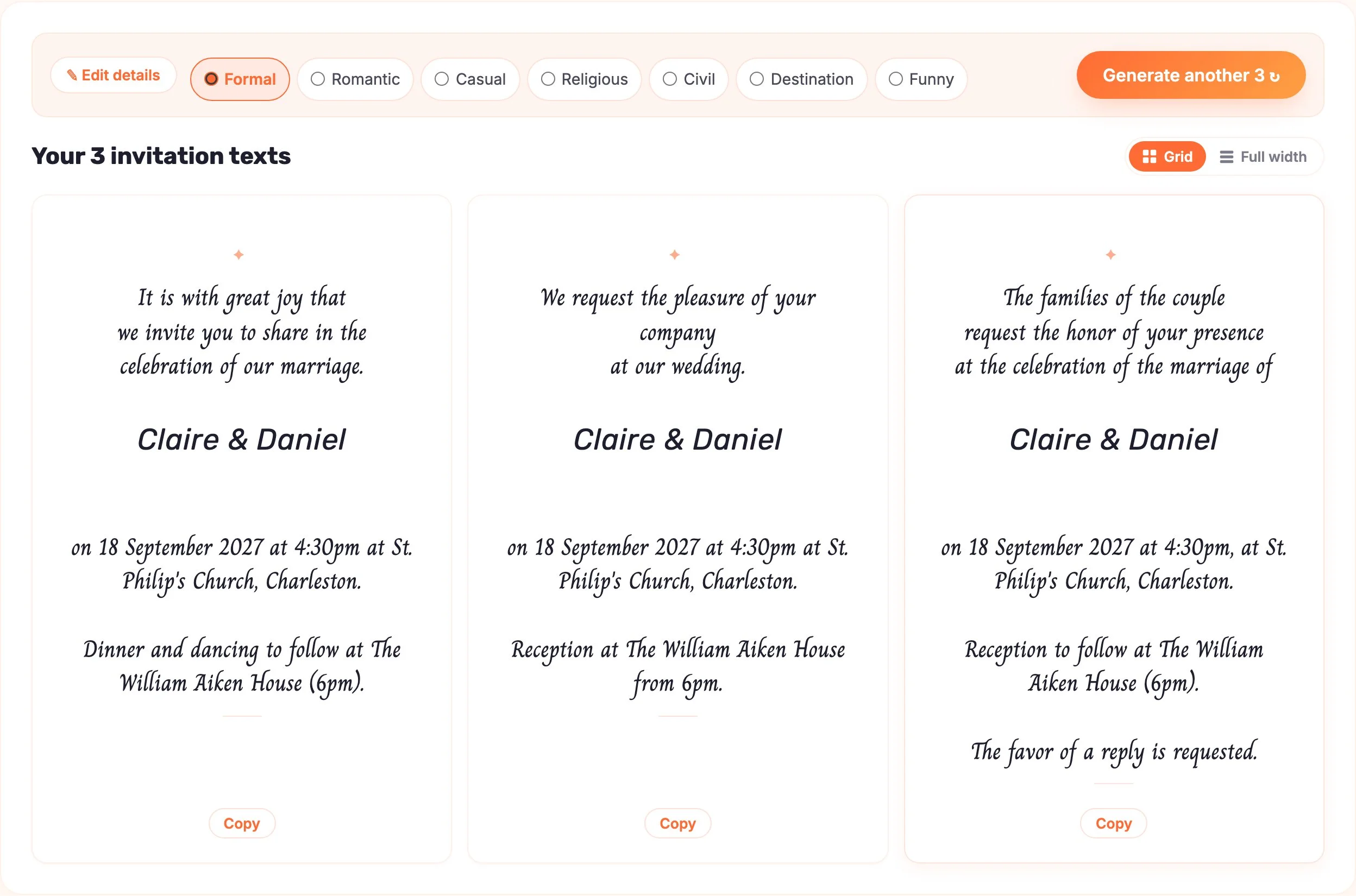
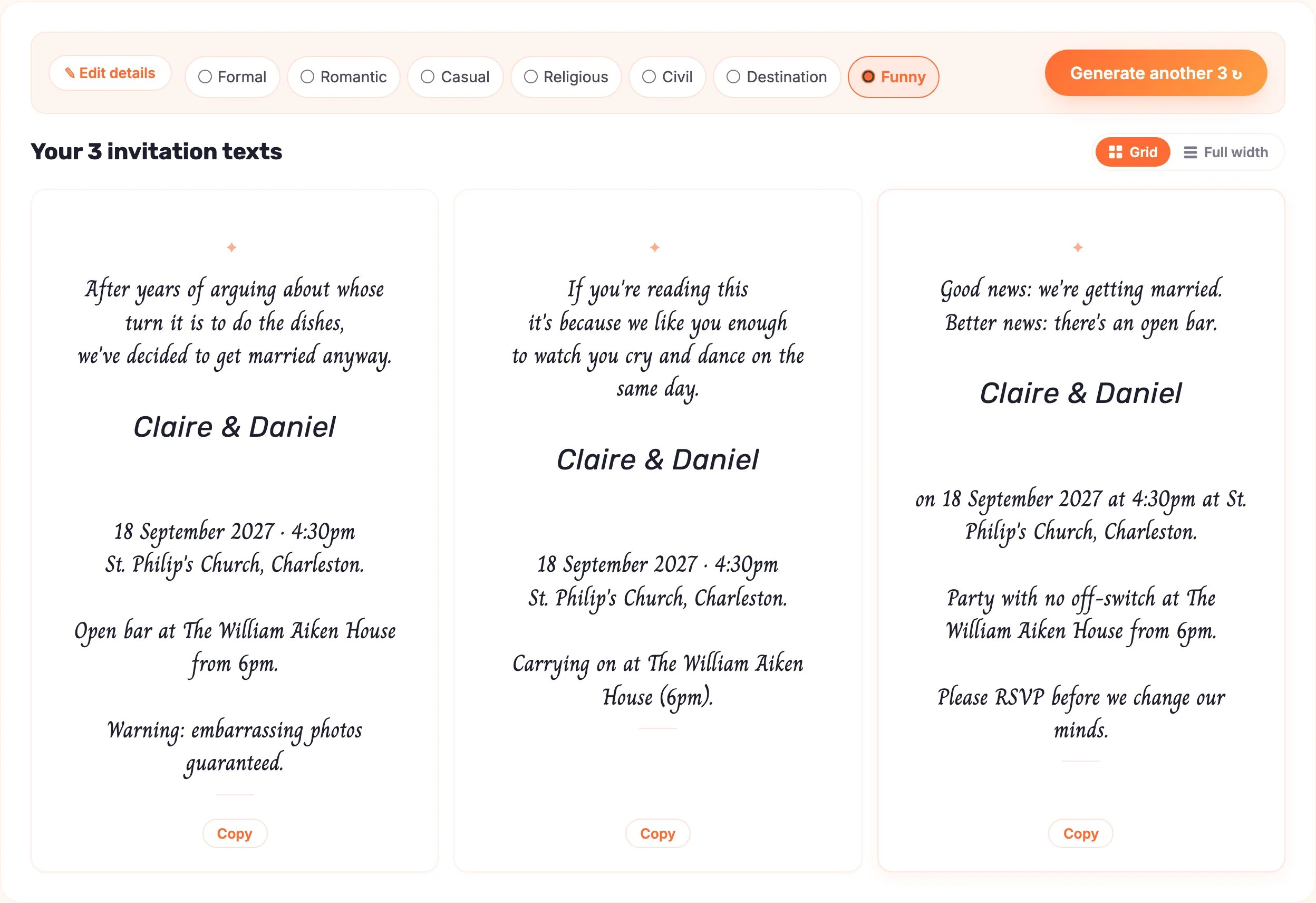
The screenshot shows our free wedding invitation wording generator with the formal style: three drafts with the same order of request, names, date and venue, and reception. It writes the date and time in numerals (“18 September 2027 at 4:30pm”) and doesn’t choose the request line by venue: one formal draft says “the honor of your presence” in American spelling, one says “the pleasure of your company” and one uses neither. For a formal printed card, rewrite the date and time in words and choose “honour” or “pleasure” by venue, as in the examples below.
Formal wedding invitation wording: who is hosting changes the first line
Formal wedding invitation wording is written in the third person and starts with the hosts’ full names, including middle names and titles. The request line follows the venue: “request the honour of your presence” for a house of worship, “request the pleasure of your company” for anywhere else. The examples below follow Emily Post’s samples for each hosting situation.
AI-generated illustration
Wedding invitation wording when the bride’s parents host
The traditional card. If the bride shares her parents’ last name, only her first and middle names appear; the groom gets his full name with “Mr.” in front.
Mr. and Mrs. Robert Allen Morgan
request the honour of your presence
at the marriage of their daughter
Claire Elizabeth
to
Mr. Daniel James Brooks
Saturday, the eighteenth of September
two thousand twenty-seven
at half after four o’clock
St. Philip’s Church
Charleston, South Carolinaand afterward at the reception
The William Aiken HouseRSVP
To name the groom’s parents without making them hosts, add a line under his name: “son of Mr. and Mrs. Thomas Edward Brooks”.
Wedding invitation wording when both parents host
Both families share the first lines, and the couple’s full names follow, because neither surname matches all the hosts.
Mr. and Mrs. Robert Allen Morgan
and Mr. and Mrs. Thomas Edward Brooks
request the honour of your presence
at the marriage of
Claire Elizabeth Morgan
to
Daniel James Brooks
Saturday, the eighteenth of September
two thousand twenty-seven
at half after four o’clock
St. Philip’s Church
Charleston, South Carolina
When the couple hosts
When the couple pays for or hosts the wedding, they issue the invitation in their own names. This example is at a historic house, not a church, so it uses “the pleasure of your company”.
Ms. Claire Elizabeth Morgan
and Mr. Daniel James Brooks
request the pleasure of your company
at their marriage
Saturday, the eighteenth of September
two thousand twenty-seven
at half after four o’clock
The William Aiken House
Charleston, South Carolina
”Together with their families”: the couple and their parents
A middle ground. It credits both families without listing every name, and it suits blended families of any shape.
Together with their families
Ms. Claire Elizabeth Morgan
and Mr. Daniel James Brooks
request the honour of your presence
at their marriage
Saturday, the eighteenth of September
two thousand twenty-seven
at half after four o’clock
St. Philip’s Church
Charleston, South Carolina
Divorced or remarried parents
When divorced parents host together, each appears on their own line with their current spouse. As in Emily Post’s sample, the bride’s full name is used because her surname differs from one set of hosts.
Mr. and Mrs. Peter James Collins
and Mr. and Mrs. Robert Allen Morgan
request the honour of your presence
at the marriage of their daughter
Claire Elizabeth Morgan
to
Mr. Daniel James Brooks
Saturday, the eighteenth of September
two thousand twenty-seven
at half after four o’clock
St. Philip’s Church
Charleston, South Carolina
If only the mother and stepfather host, the third line becomes “at the marriage of her daughter”.
When a parent has died
An invitation comes from the people hosting, so the living parent issues it alone, as in Emily Post’s sample for an only living parent:
Mr. Robert Allen Morgan
requests the honour of your presence
at the marriage of his daughter
Claire Elizabeth
to
Mr. Daniel James Brooks
Saturday, the eighteenth of September
two thousand twenty-seven
at half after four o’clock
St. Philip’s Church
Charleston, South Carolina
To honor the parent who died, Emily Post points to the ceremony program, which is “well suited for a brief tribute” in its guide to printed wedding items. The same formats work for two brides or two grooms: change “their daughter” to “their son”, and let the couple-hosted card join the names with “and”.
Casual wedding invitation wording: the couple writes in their own voice
Casual wedding invitation wording keeps the same information as a formal card but drops the titles, writes the date in numerals and sounds like the two of you. According to Emily Post, informal invitations can word dates more casually, omit titles and issue the reception invitation more simply. The couple usually signs in the first person.

Together with their families, casual version
Together with their families
Claire Morgan and Daniel Brooks
invite you to celebrate their marriage
Saturday, September 18, 2027, at 4:30 p.m.
The William Aiken House, Charleston, South CarolinaDinner and dancing to follow
Kindly reply by August 28 at claireanddaniel.yeslovey.com
Warm, from the two of you
We’re getting married, and we’d love for you to be there.
Claire & Daniel
Saturday, September 18, 2027 · 4:30 p.m.
The William Aiken House · Charleston, SCCeremony, dinner and dancing, all in one place.
Please RSVP by August 28 on our wedding website.
Short, for a photo card
Claire and Daniel are getting married!
9.18.2027 · Charleston, South Carolina
Details and RSVP at claireanddaniel.yeslovey.com
Pick one tone and keep it from the first line to the last. A card that opens with “request the honour of your presence” and closes with “can’t wait to party!” reads like two invitations glued together.
Religious wedding invitation wording
Religious wedding invitation wording names the house of worship and, on a formal card, uses “request the honour of your presence”, the phrase Emily Post reserves for ceremonies in a church, synagogue or other place of worship. Some faiths add their own line, and many couples open with a short scripture verse.
AI-generated illustration
Catholic, with a Nuptial Mass
Emily Post notes that when a Roman Catholic Mass is part of the ceremony, the card may add “and your participation in the offering of a Nuptial Mass” beneath the groom’s name.
Mr. and Mrs. Robert Allen Morgan
request the honour of your presence
at the marriage of their daughter
Claire Elizabeth
to
Mr. Daniel James Brooks
and your participation in the offering of a Nuptial Mass
Saturday, the eighteenth of September
two thousand twenty-seven
at half after four o’clock
Cathedral of Saint John the Baptist
Charleston, South Carolina
Jewish
The only difference Emily Post notes for a Jewish wedding invitation is “and” instead of “to” between the couple’s names.
Mr. and Mrs. Robert Allen Morgan
and Mr. and Mrs. Thomas Edward Brooks
request the honour of your presence
at the marriage of their children
Claire Elizabeth Morgan
and
Daniel James Brooks
Sunday, the nineteenth of September
two thousand twenty-seven
at six o’clock
Temple Beth Shalom
Charleston, South Carolina
With a verse, from the couple
“Love never fails.”
1 Corinthians 13:8With joyful hearts
Ms. Claire Elizabeth Morgan
and Mr. Daniel James Brooks
request the honour of your presence
as they are united in marriage
Saturday, the eighteenth of September
two thousand twenty-seven
at half after four o’clock
St. Philip’s Church
Charleston, South Carolina
The verse is from the New International Version on Bible Gateway (1 Corinthians 13:4–8). If your church reads another translation, check the wording in that one, because translations differ.
Courthouse and small-ceremony wedding invitation wording
Courthouse wedding invitation wording tells guests exactly which part they are invited to: the ceremony itself, or only the celebration after a private ceremony. Because a courthouse or city hall is not a house of worship, a formal version uses “the pleasure of your company”. Most couples choose a casual tone for these weddings.
AI-generated illustration
Everyone is invited to the courthouse
We’re making it official, and we want you there.
Claire Morgan & Daniel Brooks
Friday, September 17, 2027, at 11 a.m.
[Courthouse name and address]Lunch to follow at The William Aiken House.
Please RSVP by August 28.
Private ceremony, party for everyone
Claire Morgan and Daniel Brooks
will be married in a small family ceremony.
Please join us to celebrate
Saturday, September 18, 2027, at 6 p.m.
The William Aiken House, Charleston, South CarolinaDinner and dancing
Kindly reply by August 28
Already married: a reception-only invitation
We eloped!
Claire and Daniel were married on June 12, 2027,
and now we’d like to celebrate with you.Saturday, September 18, 2027 · 6 p.m.
The William Aiken House · Charleston, SCRSVP by August 28 at claireanddaniel.yeslovey.com
Funny wedding invitation wording that still gets the RSVPs back
Funny wedding invitation wording puts the joke in the opening line and keeps the logistics serious: date, time, venue and reply-by date must read at a glance. One joke is enough, and it works best with guests who know you. For a black-tie wedding, save the humor for your wedding website.
For couples who’ve been together for years
Ten years of deciding what to watch, and we finally made a big decision: we’re getting married.
Claire & Daniel
Saturday, September 18, 2027 · 4:30 p.m.
The William Aiken House, Charleston, SCRSVP by August 28. The caterer doesn’t accept “maybe.”
With a warning at the end
Claire and Daniel are getting married on September 18, 2027, at 4:30 p.m. at The William Aiken House in Charleston.
There will be dinner, there will be dancing, and there will be a reply-by date: August 28. That last part is not a joke.
For the friends who said it would never happen
Yes, really. Yes, with a date and everything.
Claire & Daniel are getting married
Saturday, September 18, 2027, at 4:30 p.m.
The William Aiken House, Charleston, South CarolinaTell us you’re coming by August 28.
For a format that’s funny too, like a board-game card or a confetti envelope, the unique wedding invitations guide has 18 ideas with sample wording for the funny ones.
Destination wedding invitation wording
Destination wedding invitation wording adds what guests need to plan travel: the city and country, every day of the celebration if there is a welcome dinner or a farewell brunch, and where to find flights, hotel blocks and transfers. The travel details belong on your wedding website; the card points to it.
A weekend abroad
Pack your bags: we’re getting married in Italy.
Claire Morgan & Daniel Brooks
invite you to celebrate their marriage
Saturday, September 18, 2027, at 5 p.m.
A villa on Lake Como, ItalyWelcome dinner Friday, September 17
Travel, hotels and RSVP at claireanddaniel.yeslovey.com
Book your room in our hotel block by June 1
Kindly reply by July 31
A beach wedding
Sand, sun and a wedding.
Claire & Daniel
Saturday, September 18, 2027 · 5:30 p.m.
Montego Bay, JamaicaWe’ve reserved rooms at two hotels on the beach. Details, room codes and RSVP are on our wedding website.
Destination guests need more notice, so the save the dates and invitations go out earlier than for a local wedding. The full calendar for these cases is in when to send wedding invitations.
Wedding invitation quotes and short lines
A wedding invitation quote is one or two lines above the hosts or the couple’s names. It can be your own sentence or a quote from scripture or poetry; if it’s a quote, credit the author and check the exact words in a reliable edition. These lines work on paper and on a digital invitation.

AI-generated illustration
Short lines of your own
- Two hearts, one promise, and a party to celebrate it.
- We said yes. Now we’d love for you to say yes, too.
- After all this time together, one thing is missing: celebrating it with you.
- Join us as we start forever.
- Two families, two hometowns, one “I do.”
- Save us a dance, and save the date.
- Together since 2017; married as of September 18.
Wedding invitation quotes, with the source checked
- “Love never fails.” 1 Corinthians 13:8, New International Version.
- “Love is patient, love is kind.” 1 Corinthians 13:4, same translation.
- “Many waters cannot quench love; rivers cannot sweep it away.” Song of Songs 8:7, New International Version.
- “Where you go I will go, and where you stay I will stay.” Ruth 1:16, New International Version.
- “Two are better than one.” Ecclesiastes 4:9, New International Version.
- “Let me not to the marriage of true minds / Admit impediments.” William Shakespeare, Sonnet 116 (Folger Shakespeare Library).
- “How do I love thee? Let me count the ways.” Elizabeth Barrett Browning, Sonnet 43 (Academy of American Poets).
Many love quotes online carry the name of someone who never wrote them. If you can’t find the line in an edition of the work, use a line of your own instead.
How to word no kids, registry, dress code and plus-ones
The delicate parts of a wedding invitation are mostly handled off the card. Emily Post’s rule is that the invitation never mentions gifts, never prints “no children”, and leaves out attire except for “Black tie” on a reception invitation. The envelope says who is invited, and your wedding website explains the rest in one friendly sentence each.

AI-generated illustration
How to say no kids on a wedding invitation
Don’t print “no children” or “adults only” on the invitation, says Emily Post’s advice on signaling an adults-only wedding. The names on the envelope say exactly who is invited: “Mr. and Mrs. Hayward” means the parents only, while “The Hayward Family” includes the children. Ask close family to spread the word, and add a line to your website FAQ:
We love your little ones, but our celebration is adults-only. We hope you enjoy a night off with us.
The wedding website FAQs guide has more answers for kids and plus-ones.
Registry and honeymoon fund
Registry information doesn’t go on the wedding invitation or any of its enclosures. Emily Post’s registry etiquette says to share it by word of mouth and on your wedding website, and its invitations column adds that the card shouldn’t say “no gifts, please” either. A honeymoon fund is fine as one of up to three registries, and the wording goes on the website:
Your presence is the best gift. If you’d like to give something more, we’ve registered at two stores and set up a small honeymoon fund. You’ll find the links below.
RSVP deadline
Give an exact date. Emily Post puts the reply-by date “usually two to three weeks before the wedding”, and our wedding invitation timeline uses three to four weeks. Three weeks satisfies both, which is why every example here uses August 28 for a September 18 wedding.
Kindly reply by August 28, when we send our final count to the caterer.
Dress code
Emily Post advises against mentioning attire on the wedding invitation. If it’s necessary, “Black tie” may be printed in the lower right corner of a reception invitation. Guests also take their cue from how formal the invitation looks, so put the detail on your website:
Dress code: cocktail attire. The ceremony is on the lawn, so leave the stilettos at home.
Plus-ones
The envelope decides, not a line on the card. Emily Post calls “and Guest” awkward on the outer envelope; if you know the guest’s name, use it. With two envelopes, the outer one reads “Mr. James Smith” and the inner one “Mr. James Smith and Guest”; with one envelope, add a short note: “You’re welcome to bring a guest. Please let us know their name.”
If there’s no plus-one, the single name on the envelope already says so.
How to write dates, times and names on a formal wedding invitation
On a formal wedding invitation, the date, the year and the time are spelled out in words, the day and month are capitalized, the year is not, and half hours are written “half after”. Titles such as Mr. and Mrs. stay abbreviated, while “Doctor” is spelled out. These rules come from Emily Post’s guide to formal wording.

AI-generated illustration
| Write | Avoid | Rule |
|---|---|---|
| Saturday, the eighteenth of September | Saturday, September 18th | Date spelled out; day of the week and month capitalized |
| two thousand twenty-seven | Two Thousand and Twenty-Seven · 2027 | Year spelled out, lowercase, with no “and” |
| at half after four o’clock | at 4:30 p.m. · half past four | Emily Post prefers “half after” to “half past” or “four-thirty” |
| at four o’clock | at four o’clock in the afternoon | ”In the afternoon” and “in the evening” are not necessary |
| Mr. and Mrs. Robert Allen Morgan | Mister and Missus Robert A. Morgan | Titles stay abbreviated; hosts’ names include middle names |
| Doctor and Mrs. Robert Allen Morgan | Dr. and Mrs. Robert Allen Morgan | Doctor is spelled out unless the line gets too long |
| Charleston, South Carolina | Charleston, SC | State spelled in full; it may be omitted if all guests are local |
| request the honour of your presence | request the honor of your presence (church) | British “honour” is the convention for a house of worship |
| at the marriage of their daughter Claire Elizabeth to Mr. Daniel James Brooks | at the marriage of their daughter Claire Elizabeth and Mr. Daniel James Brooks | When parents host, “to” joins the names; Jewish invitations use “and” |
Because the formal rules spell everything out, numerals and “p.m.” mark a card as casual. Casual cards have more freedom: Emily Post’s informal samples include “July 30, 2018” next to “at six o’clock”.
The envelopes follow different rules. According to Emily Post’s guide to addressing wedding invitations, titles are abbreviated there (Mr., Mrs., Ms., Dr.), words like “Street” are spelled out, and middle initials are not used: write the middle name in full or leave it out.
Wedding RSVP card wording
The wedding RSVP card, or response card, is a smaller card in the invitation set that guests fill in and mail back. It has a line beginning with “M” for the guests’ names, accept and regret lines, and a reply-by date. Emily Post notes that reply cards go with reception invitations, never with ceremony-only ones.

AI-generated illustration
Formal reply card
M____________________________
_____ accepts with pleasure
_____ declines with regretThe favour of a reply is requested
by the twenty-eighth of August
The guest completes the “M” with their title and name, such as “Mr. and Mrs. James Bailey”, plus the name of their guest if one was invited. Emily Post’s response card guide also accepts “will attend / will not attend” and “Please reply by”.
Casual reply card with a meal choice
Name(s) ____________________________
_____ Can’t wait to celebrate
_____ Will celebrate from afarPlease write your initials next to your entrée:
_____ Beef · _____ Fish · _____ VegetarianKindly reply by August 28
Reply online instead of by mail
Kindly reply by August 28
at claireanddaniel.yeslovey.com
If you take replies by mail and online, add a printed line to the reply card: “You may also reply by way of our wedding website.” If replies go only to email or a phone number, Emily Post’s response card guide says to include that information on the card and skip the reply envelope.
Paper or digital wedding invitations: how much text fits on each
A paper wedding invitation carries the full wording and, at most, one quote; the details go on enclosure cards or your wedding website. A digital wedding invitation is read on a phone, so its message shrinks to the news, the date, the place and a link to the invitation with everything else.

AI-generated illustration
On paper, the bottom of the card or the reply card is the place for your wedding website address or a QR code. That moves the map, the schedule, hotels and the registry off the card; they change more often than the date does.
In a digital invitation, the wording is the message that goes with the link. Two or three lines are enough, because the guest sees the full invitation when they open it and replies from there:
Claire and Daniel are getting married on September 18, 2027, in Charleston, and we’d love for you to be there. Here’s your invitation, with all the details and the RSVP: claireanddaniel.yeslovey.com
To draft the text from your own details, the wedding invitation wording generator is free and needs no account. Enter your names, date, time and venues, pick one of seven styles (Formal, Romantic, Casual, Religious, Civil, Destination or Funny) and copy one of the three texts it writes. To see how a digital invitation works, with the animated intro and the RSVP form inside, visit the digital wedding invitations page.
Put your wording on a digital wedding invitation
Free to create and preview. Publish it for $59, one-time, with an animated intro, music and RSVPs built in.
FAQ
Before you print or send
Pick one tone and keep it on every line, check that the six parts are there, and run the dates, times and names past the table above. Then read the card aloud once: any line you would never say out loud is a line to rewrite.
For the full calendar, from save the dates to the RSVP deadline and the final headcount, see when to send wedding invitations.